
The company building what the AI era actually needs.
Antimatter brings together flexible power, modular data centers, and distributed cloud software into one operating company — under one thesis, one leadership team, and one integrated stack.
Our mission: to make sovereign, sustainable, and intelligent computing accessible to everyone, from individual developers to global enterprises and governments.
What Antimatter is.
Antimatter is the company formed by Data Factory, Policloud, and Hivenet — three operating businesses linked by one system, one mission, and one leadership team.
This is not a merger of convenience. It is a deliberate synthesis: flexible power, modular hardware at the edge, and distributed cloud intelligence, combined because they are structurally stronger together than apart.
Infrastructure ahead of adoption. Again.
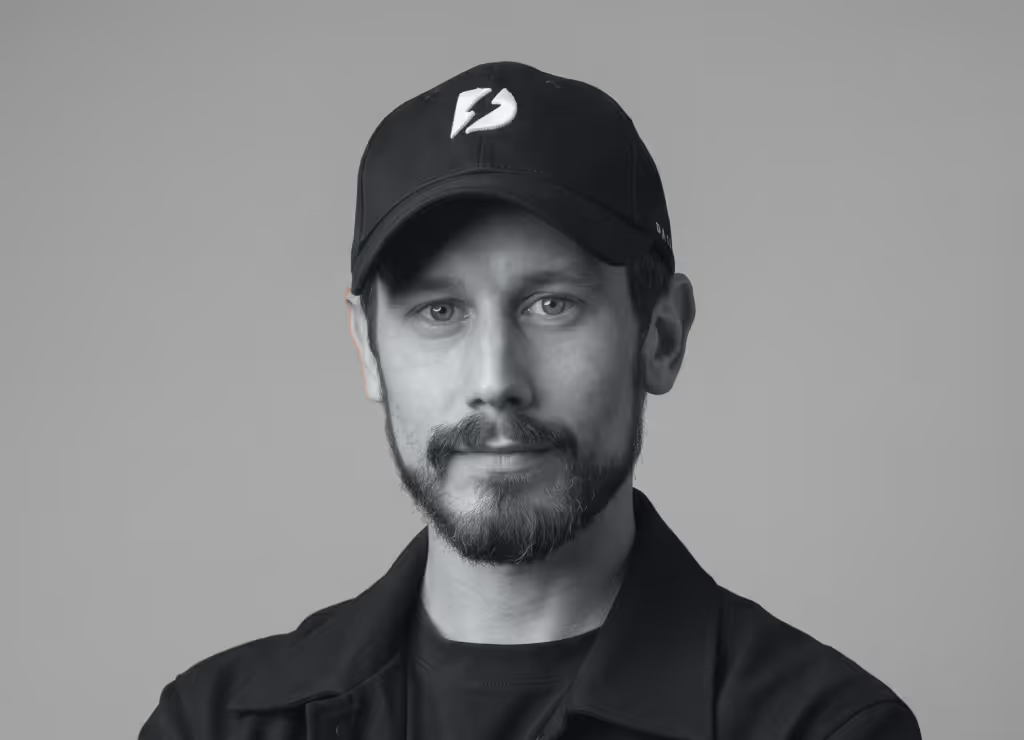
David Gurlé — Co-founder, Executive Chairman & CEO, Antimatter; CEO, Policloud.
David Gurlé has built infrastructure ahead of every major shift of the last thirty years: real-time communications at Microsoft, enterprise collaboration at Skype and Thomson Reuters, secure messaging at Symphony — a company he founded and scaled to a $1.8 billion valuation with backing from JPMorgan, Goldman Sachs, and Deutsche Bank.
Antimatter continues that pattern. It is what you build when AI demand, energy scarcity, and distributed computing stop being three separate stories and become one system problem.
"Every era has its impossibles until someone decides otherwise."
— David Gurlé
At a glance
30 years
Building infrastructure ahead of tech shifts
Seven companies
Founded or led
$1.8B
Symphony valuation
Chevalier de la Légion d'Honneur
The team behind Antimatter.

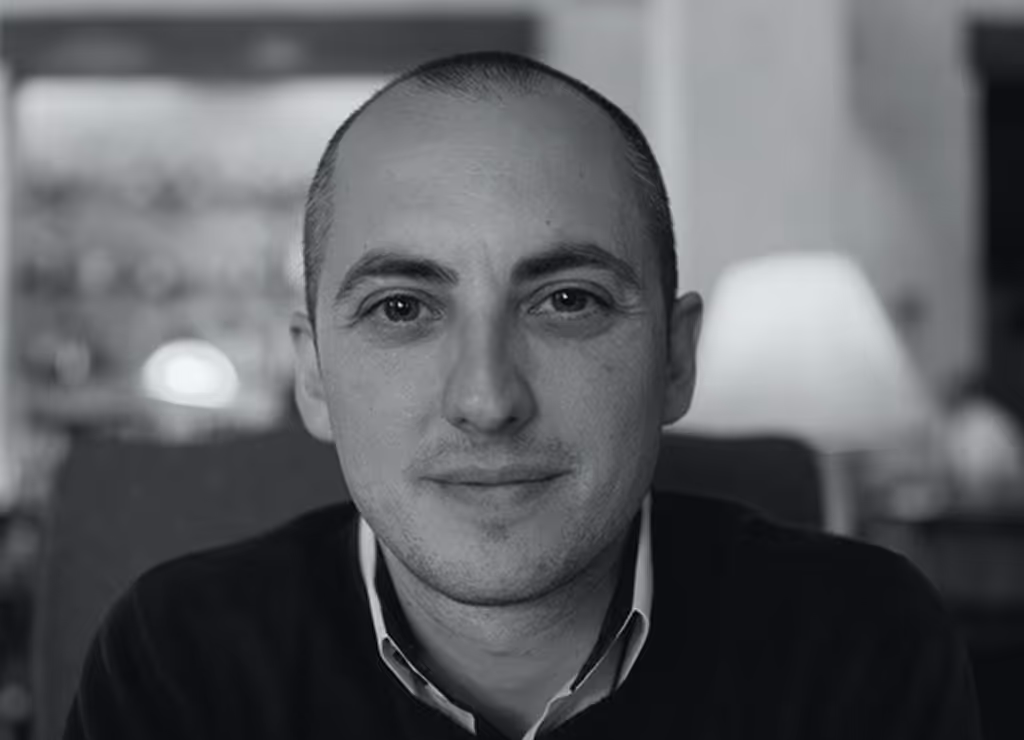
The companies that built Antimatter.
Three operating businesses. Three independent customer bases. One integrated stack.


ENERGY
Founded by Richard Esteve, Richard Détente, Philippe Erb and Guillaume Goualard.
Operates flexible-power compute across Texas and Oregon. Contributes the majority of Antimatter's present-day operational power (26+ MW on launch day) and anchors the 1 GW+ of power secured across the group. Pioneered the use of bitcoin-mining infrastructure as grid-stabilization and AI compute.

INFRASTRUCTURE
Founded March 2025 · €7.5M seed
Backing from Global Ventures and OneRagtime, including Inria participation. Modular micro data centers. 10 units deployed across 8 sites on launch day (2026), 3,400+ GPUs in the field — on a build path to 100 units in 2027 and 1,000 by 2030.
ORCHESTRATION
Founded 2022 by David Gurlé · €7M seed from Global Ventures.
Founded by David Gurlé with €7M from Global Ventures and OneRagtime. Distributed cloud software platform. 500,000+ users worldwide. Research partnership with Inria.
Why we came together
Every company that forms Antimatter was built to solve a real problem. None was built to be acquired or merged. They came together because they share a common cause: the next wave of AI infrastructure cannot be built by any one of us alone, and should not be.
That stack brings together hardware at the edge, distributed cloud intelligence, and flexible energy capability — a fuller stack than any one of us could build alone, fast enough.
Together, they form Antimatter: one system built to connect power, compute, and services under a single company vision.
Operating depth, research backing, real deployments.
Antimatter is not a first-time team. Its people have shipped category-defining infrastructure at Microsoft, Skype, Symphony, Inria, and three operating companies.
Founding team from Microsoft, Skype, and Symphony
Research collaboration with Inria — including the CUPSELI program, spanning 11 Inria teams across 6 research centers, 9 doctoral students, and 2 post-docs.
Operational deployments in France, the GCC, and the United States (Texas, Oregon)
Where Antimatter is already at work.
Research
Hivenet's collaboration with Inria began with Alvearium. Today, CUPSELI — a joint research program spanning 11 Inria teams across 6 research centers, 9 doctoral students, and 2 post-docs — focuses on distributed computing and AI.
Public deployment
Sovereign cloud and public-sector deployments for the City of Cannes, the Département des Alpes-Maritimes, and the Département de la Côte d'Or.
Technology
AMD silicon for high-density compute. Seagate enterprise storage. Long-term supply agreements structured to insulate the platform from hardware supply shocks.








What we stand for.
Three principles guide every architectural choice.

Sovereignty.
Control over where compute runs, where data lives, and how critical infrastructure is governed.

Resilience.
Distributed architecture that does not concentrate risk in a handful of sites.

Frugality.
Disciplined use of energy, capital, and physical resources — against the logic of endless concentration.
